Cox Proportional Hazards Model

Edwin Alvarado, Darnell Thomas, and Michael Ho

Overview

  • What is the Cox Proportional Hazards Model?

  • Used to evaluate the association between survival time of a patient and one or more risk factors

  • Known for its ability to handle censored data

  • Can account for “realistic” outcomes of observations (i.e., the patient surviving)

Defining the Statistical Model

The composition of the model is as follows:

\[ h_i(t) = h_0(t) \times exp(\beta_1X_{1i} + \beta_2X_{2i} + ... + \beta_kX_{ki}) \]

Where \(H_0 (t)\) is considered to be the baseline hazard function of the model. \(\beta_k\) are model parameters.

The Hazard Ratio

Consider the following example:

\[ HR = {h_{pre}(t) \over h_{post}(t)} = {h_0(t)\times exp(0.0177 \times X_{pre}) \over h_0(t) \times exp(0.0177 \times X_{post})} \] \[ = {exp(0.0177 \times 1) \over exp(0.0177 \times 0)} = 1.018\] Similar to Odds Ratio in that:

  • HR > 1 = Positive Effect
  • HR < 1 = Negative Effect
  • HR = 1 = No Effect

Applications and Limitations

  • Often used in medical field, e.g. clinical trials

  • While commonly used in medical research, can be applied to other fields, such as finance or social sciences

  • Originally form of the model, could not account for time-dependent variable effects

    • Proportional Hazard Assumption

Case Study: VA Lung Cancer Trial

Goals

  • Determine if treatment used in trial has positive effect on survival time
  • Determine if any other variables have significant effect on survival time
  • Properly test assumptions and fit the Cox Proportional Hazards Model

Case Study: VA Lung Cancer Trial

Table 1: Data Definition
Attribute Type Description
stime Numeric survival or follow-up time, in days
status Numeric dead or alive/censored; 0 (alive), 1 (dead)
treat Nominal treatment, either standard or test (chemotherapy); 1 (standard), 2 (test)
age Numeric patient age in years
Karn Numeric Karnofsky score of patient performance, on scale of 0 to 100
diag Numeric patient time since diagnosis, measured at time of entry to trial, in months
cell Nominal one of four cell types; 1 (squamous), 2 (small cell), 3 (adeno), 4 (large)
prior Nominal denotes prior therapy; 10 (yes), 0 (no)
Table 2: Sample Rows from VA Lung Trial Data
stime status treat age Karn diag.time cell prior
72 1 1 69 60 7 1 0
411 1 1 64 70 5 1 10
228 1 1 38 60 3 1 0
126 1 1 63 60 9 1 10
118 1 1 65 70 11 1 10
10 1 1 49 20 5 1 0
  • 137 Observations of patients with inoperable lung cancer
  • Includes Censored Data
  • Per the National Cancer Institute, the Karnofsky score is standard way to measure how well a patient can perform ordinary tasks. A higher score indicates a higher ability to do these tasks

Summary Statistics

Table 3: Summary Statistics for VA Lung Trial Data
stime age Karn diag.time
Min. : 1.0 Min. :34.00 Min. :10.00 Min. : 1.000
1st Qu.: 25.0 1st Qu.:51.00 1st Qu.:40.00 1st Qu.: 3.000
Median : 80.0 Median :62.00 Median :60.00 Median : 5.000
Mean :121.6 Mean :58.31 Mean :58.57 Mean : 8.774
3rd Qu.:144.0 3rd Qu.:66.00 3rd Qu.:75.00 3rd Qu.:11.000
Max. :999.0 Max. :81.00 Max. :99.00 Max. :87.000
Table 4: Summary Count Statistics for VA Lung Trial Data
status treat cell prior
0: 9 1:69 1:35 0 :97
1:128 2:68 2:48 10:40
NA NA 3:27 NA
NA NA 4:27 NA

Data Visualization

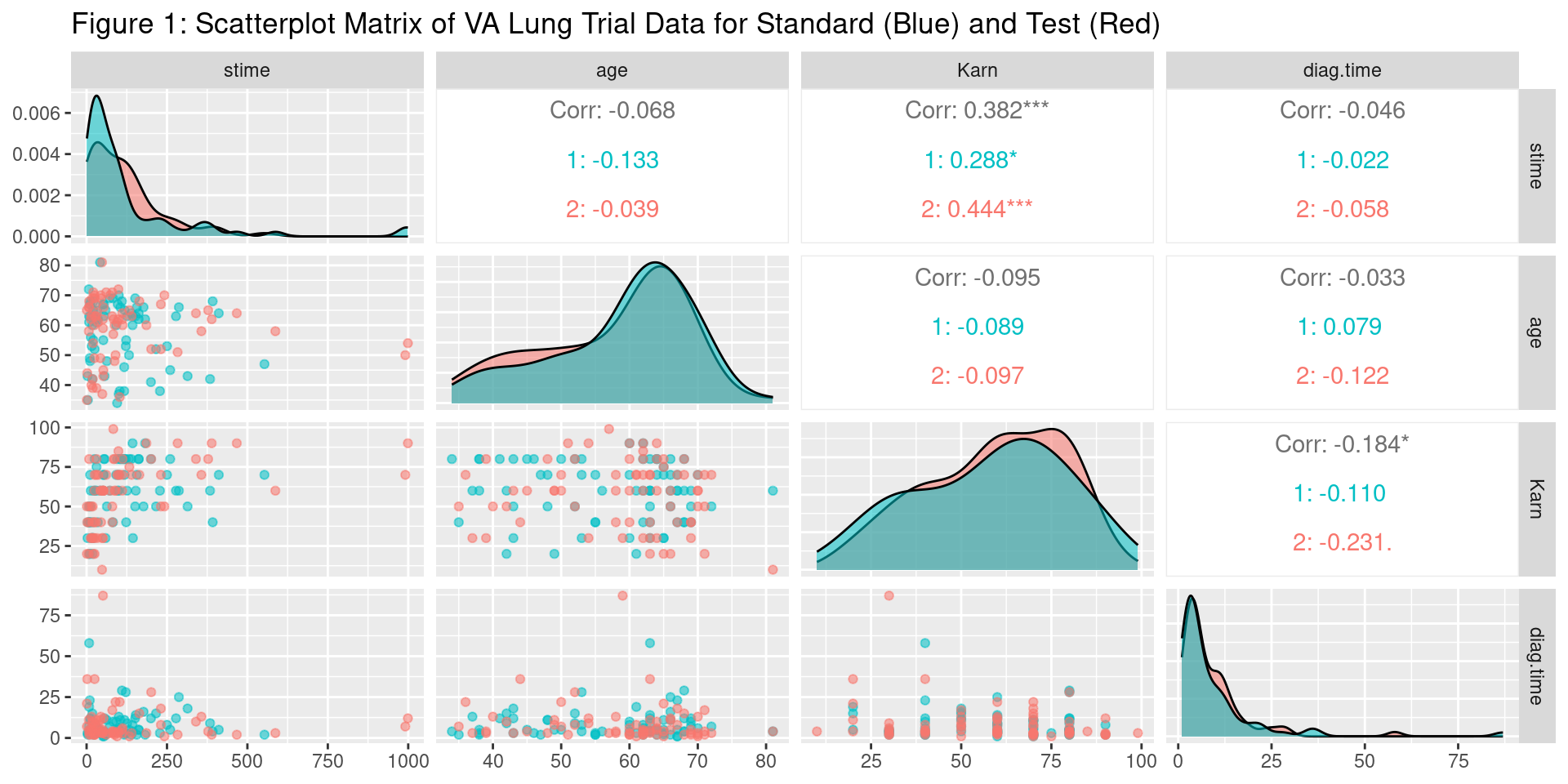
  • Distributions are roughly similar between standard and test treatment groups

  • Karnofsky and survival time seem positively correlated

#Create a scatter plot matrix using the GGally package
library(GGally)
library(tidyverse)
va_subset <- VA[, c("stime", "age", "Karn", "diag.time", "treat")]

ggpairs(va_subset, title = "Figure 1: Scatterplot Matrix of VA Lung Trial Data for Standard (Blue) and Test (Red)", 
        columns = c("stime", "age", "Karn", "diag.time"), ggplot2::aes(color = treat),
        lower = list(continuous = "points", combo = "dot_no_facet", mapping = ggplot2::aes(color=treat, alpha = 0.8)),
        diag = list(continuous = wrap("densityDiag"), mapping = ggplot2::aes(color = treat, alpha = 0.1))) +
  scale_color_manual(values = c("#00BFC4", "#F8766D"))

Statistical Model

Recall the composition:

\[ h_i(t) = h_0(t) \times exp(\beta_1X_{1i} + \beta_2X_{2i} + ... + \beta_kX_{ki}) \]

Model in R

Cox PH model for a single variable (treat)

# Import packages
library(survival)

# Fit Cox PH Model for treatment only
Y = Surv(VA$stime, VA$status)
coxph(Y ~ treat, data=VA)
Call:
coxph(formula = Y ~ treat, data = VA)

          coef exp(coef) se(coef)     z     p
treat2 0.01774   1.01790  0.18066 0.098 0.922

Likelihood ratio test=0.01  on 1 df, p=0.9218
n= 137, number of events= 128 
summary(coxph(Y ~ treat, data=VA))
Call:
coxph(formula = Y ~ treat, data = VA)

  n= 137, number of events= 128 

          coef exp(coef) se(coef)     z Pr(>|z|)
treat2 0.01774   1.01790  0.18066 0.098    0.922

       exp(coef) exp(-coef) lower .95 upper .95
treat2     1.018     0.9824    0.7144      1.45

Concordance= 0.525  (se = 0.026 )
Likelihood ratio test= 0.01  on 1 df,   p=0.9
Wald test            = 0.01  on 1 df,   p=0.9
Score (logrank) test = 0.01  on 1 df,   p=0.9
library(gtsummary)
coxph(Y ~ treat, data=VA) %>% tbl_regression(exponentiate = T) %>% 
add_glance_table(include = c(logLik, concordance))
Characteristic HR1 95% CI1 p-value
treat
    1
    2 1.02 0.71, 1.45 >0.9
Log-likelihood -505
c-index 0.525
1 HR = Hazard Ratio, CI = Confidence Interval

Proportional Hazard Assumption

  • The proportional hazard assumption is means that hazard ratio (HR) is constant over time.

  • Variables and regression coefficients are time-independent (no change over course of study).

  • Methods of checking PH assumption

    1. Schoenfeld Residuals vs Time Plot

    2. Statistical test of Schoenfeld Residuals

    3. Log-Log Survival Curve

1. Residuals vs Time Plot

PH assumption is valid when coefficient is constant over time.
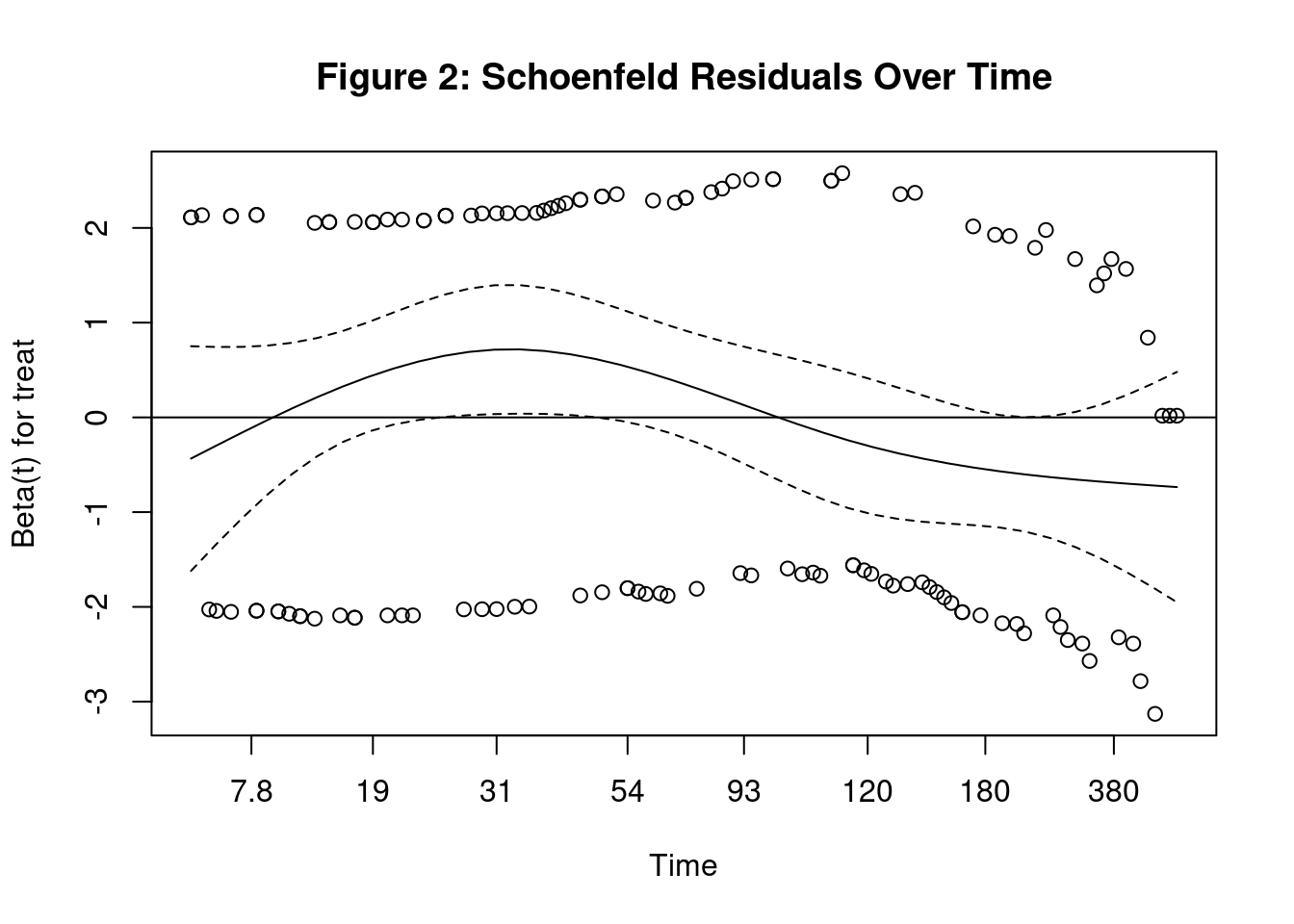
Plot of scaled Schoenfeld residuals and estimated beta versus time

2. Statistical Test

Test if Schoenfeld residuals are correlated with time. The null hypothesis \(H_0\) is that the residuals are not correlated with time.

If p-value < \(\alpha\): 0.05, then PH assumption is violated.

cox.zph(coxph(Y ~ treat, data=VA), transform = rank)
       chisq df    p
treat   3.53  1 0.06
GLOBAL  3.53  1 0.06

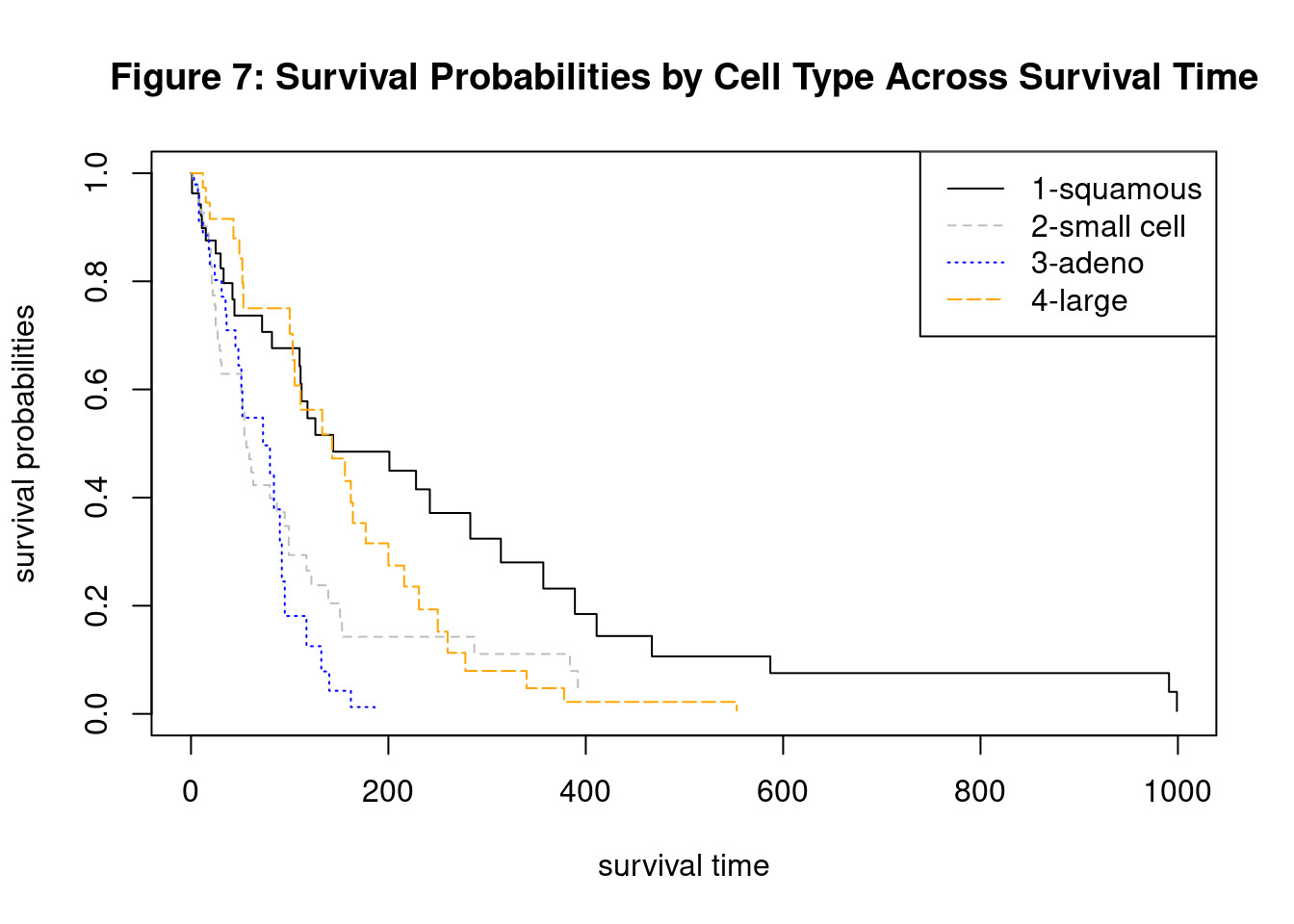
3. Survival Curves

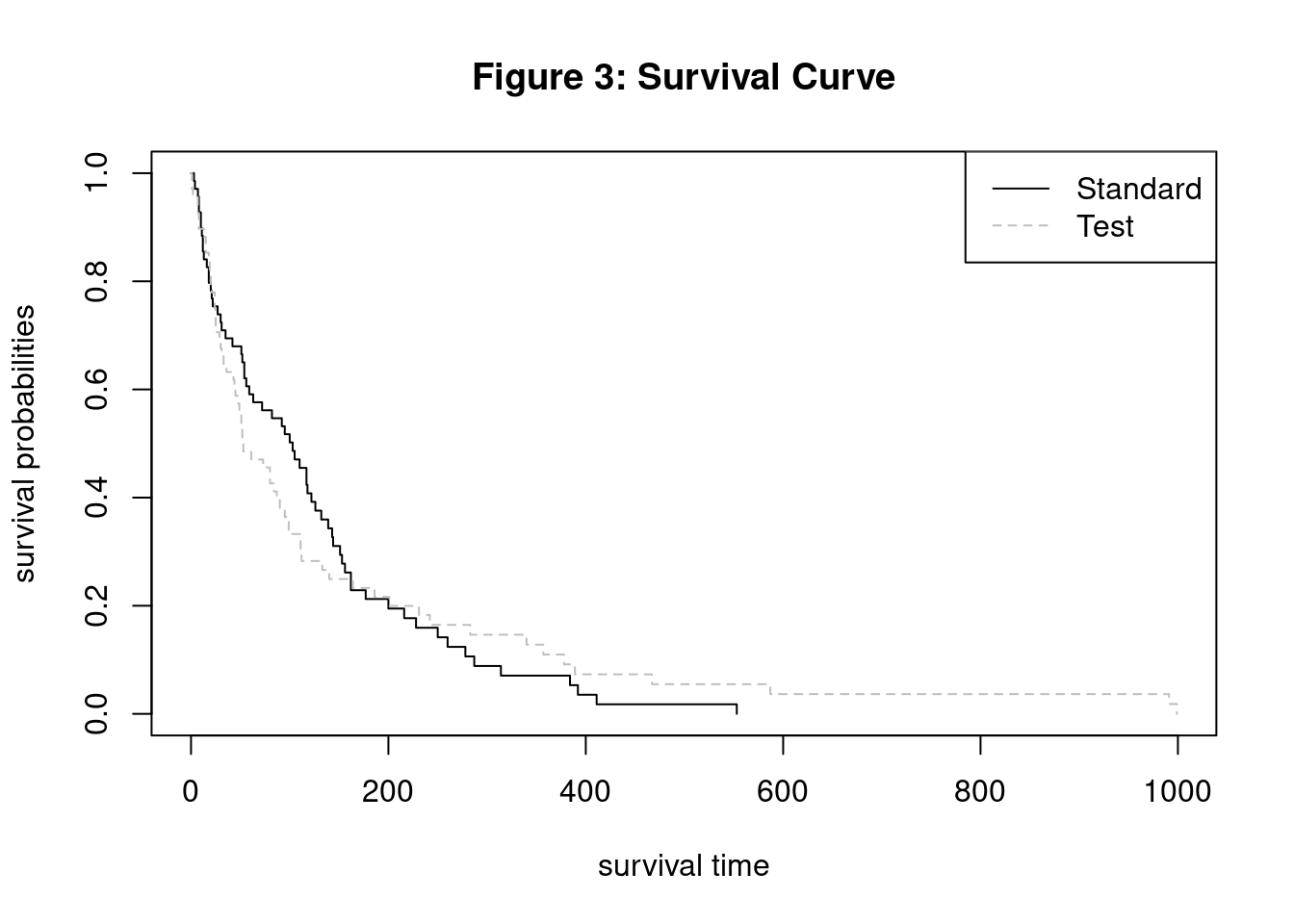
Kaplan-Meier Survival Curve

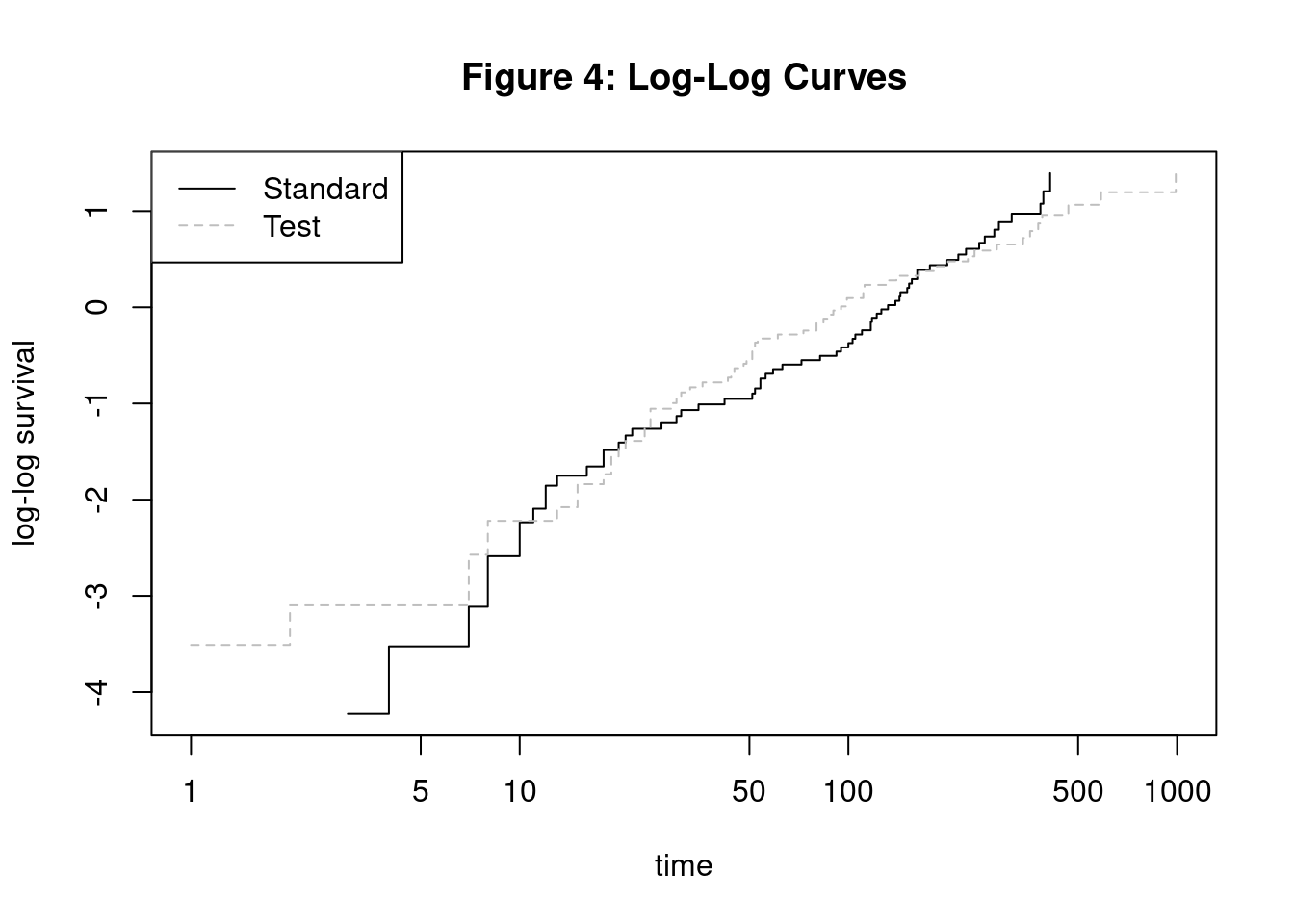
If log-log survival curves are parallel then the PH assumption is appropriate. Since curves cross, PH assumption is violated.

Multiple Variable Cox Model

coxph(Y ~ treat + age + Karn + diag.time + cell + prior, data=VA)
Call:
coxph(formula = Y ~ treat + age + Karn + diag.time + cell + prior, 
    data = VA)

                coef  exp(coef)   se(coef)      z        p
treat2     2.946e-01  1.343e+00  2.075e-01  1.419  0.15577
age       -8.706e-03  9.913e-01  9.300e-03 -0.936  0.34920
Karn      -3.282e-02  9.677e-01  5.508e-03 -5.958 2.55e-09
diag.time  8.132e-05  1.000e+00  9.136e-03  0.009  0.99290
cell2      8.616e-01  2.367e+00  2.753e-01  3.130  0.00175
cell3      1.196e+00  3.307e+00  3.009e-01  3.975 7.05e-05
cell4      4.013e-01  1.494e+00  2.827e-01  1.420  0.15574
prior10    7.159e-02  1.074e+00  2.323e-01  0.308  0.75794

Likelihood ratio test=62.1  on 8 df, p=1.799e-10
n= 137, number of events= 128 
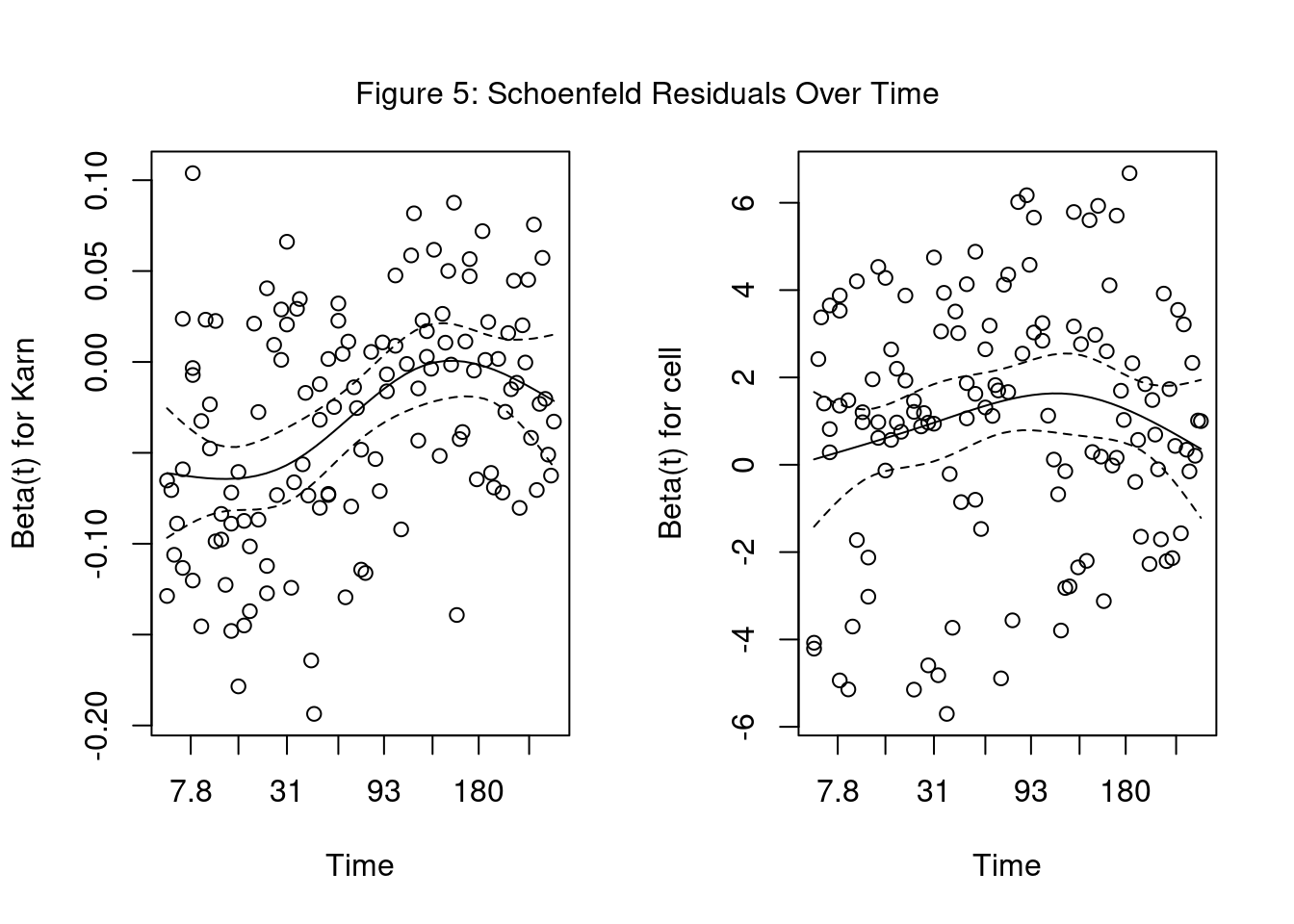
cox.zph(coxph(Y ~ treat + age + Karn + diag.time + cell + prior, data=VA), transform=rank)
             chisq df       p
treat      0.27566  1 0.59956
age        1.76999  1 0.18338
Karn      13.53155  1 0.00023
diag.time  0.00766  1 0.93025
cell      15.39791  3 0.00151
prior      2.23094  1 0.13527
GLOBAL    35.22254  8 2.4e-05

Schoenfeld plot of nonproportional variables

Options when PH assumption not met

  1. Subset data based time

    • Start Cox PH model after certain time period (ie fit model for 180-day survivors)

    • Doesn’t consider individuals whose event occurred before 180 days

  2. Stratified Cox model

    • Obtain separate models for each group (ie Cell Type)

    • Cannot compare HR across stratified groups

More Options when PH assumption not met

  1. Extended Cox model

    • Specify function time-varying coefficients and/or time-dependent variables

    • Could be harder to interpret depending on function

  2. Combination of 1, 2, or 3

1. Fitting Cox model for 180-day survivors

  • Only 27 individual left in study after 180 days.

  • Sample too small to make conclusions.

2. Stratified Cox model

Assumes a different baseline hazard function for each Cell Type.

Stratified cox model

where \[g = 1, 2, 3, 4 \text{ (number of cell types)}\]
coxph(Y ~ treat + age + Karn + diag.time + strata(cell) + prior, data=VA)
Call:
coxph(formula = Y ~ treat + age + Karn + diag.time + strata(cell) + 
    prior, data = VA)

               coef exp(coef)  se(coef)      z        p
treat2     0.285902  1.330962  0.210009  1.361    0.173
age       -0.011821  0.988249  0.009846 -1.201    0.230
Karn      -0.038262  0.962461  0.005932 -6.450 1.12e-10
diag.time -0.003439  0.996567  0.009075 -0.379    0.705
prior10    0.169069  1.184201  0.235667  0.717    0.473

Likelihood ratio test=44.27  on 5 df, p=2.042e-08
n= 137, number of events= 128 

3. Extended Cox model

\[h_i(t)= h_0(t) \times exp(\beta_1(t)X_{1i} + ... + \beta_k(t)X_{ki}) \]Used to specify a function for the coefficients that change with time (linear, logarithmic, a step function, etc).

We used a step function for time intervals of 0-90, 90-180, and 180+ days.

#Creating tgroup column for each individual
VA.cp = survSplit(Surv(stime, status)  ~ ., data=VA, cut=c(90,180), episode="tgroup")

# Output first 7 entries
VA.cp[1:7, c("age","Karn","cell","tstart", "stime", "status", "tgroup")]
  age Karn cell tstart stime status tgroup
1  69   60    1      0    72      1      1
2  64   70    1      0    90      0      1
3  64   70    1     90   180      0      2
4  64   70    1    180   411      1      3
5  38   60    1      0    90      0      1
6  38   60    1     90   180      0      2
7  38   60    1    180   228      1      3
coxph(Surv(tstart, stime, status) ~ treat + age + diag.time + cell + prior + Karn:strata(tgroup),
                 data=VA.cp)
Call:
coxph(formula = Surv(tstart, stime, status) ~ treat + age + diag.time + 
    cell + prior + Karn:strata(tgroup), data = VA.cp)

                                 coef exp(coef)  se(coef)      z        p
treat2                       0.112060  1.118580  0.211447  0.530 0.596133
age                         -0.010939  0.989120  0.009358 -1.169 0.242412
diag.time                   -0.002008  0.997994  0.008781 -0.229 0.819087
cell2                        0.959954  2.611577  0.285245  3.365 0.000764
cell3                        1.144719  3.141558  0.306753  3.732 0.000190
cell4                        0.345923  1.413293  0.284123  1.218 0.223411
prior10                      0.084232  1.087881  0.234362  0.359 0.719290
Karn:strata(tgroup)tgroup=1 -0.048006  0.953128  0.006561 -7.317 2.53e-13
Karn:strata(tgroup)tgroup=2  0.007040  1.007065  0.013324  0.528 0.597241
Karn:strata(tgroup)tgroup=3  0.000932  1.000932  0.014981  0.062 0.950397

Likelihood ratio test=82.3  on 10 df, p=1.773e-13
n= 225, number of events= 128 

4. Stratified-Extended (SE) Cox model

We can both stratify on cell type while using the extended model for the Karnofsky score.

coxph(Surv(tstart, stime, status) ~ treat + age + diag.time + strata(cell) + prior + Karn:strata(tgroup),
                 data=VA.cp)
Call:
coxph(formula = Surv(tstart, stime, status) ~ treat + age + diag.time + 
    strata(cell) + prior + Karn:strata(tgroup), data = VA.cp)

                                 coef exp(coef)  se(coef)      z        p
treat2                       0.160901  1.174569  0.215924  0.745    0.456
age                         -0.012389  0.987687  0.009893 -1.252    0.210
diag.time                   -0.004278  0.995731  0.008938 -0.479    0.632
prior10                      0.164566  1.178882  0.237594  0.693    0.489
Karn:strata(tgroup)tgroup=1 -0.049032  0.952150  0.006818 -7.192 6.41e-13
Karn:strata(tgroup)tgroup=2  0.008194  1.008228  0.015464  0.530    0.596
Karn:strata(tgroup)tgroup=3 -0.019916  0.980281  0.020078 -0.992    0.321

Likelihood ratio test=57.35  on 7 df, p=5.104e-10
n= 225, number of events= 128 

Reducing Model

We can use the Log-Likelihood value (\(L\)) to determine if there is a significant difference in nested models.

\[\chi_{LR}^2 = -2\ln L_\text{reduced-model} - (-2\ln L_\text{full-model})\]

If \(\chi_{LR}^2 > \chi_{df,\alpha}^2\) (ie p-value < 0.05), then significant difference in models

# Using anova with Likelihood ratio test
anova(cox.modse_r, cox.modse, test="LRT")
Analysis of Deviance Table
 Cox model: response is  Surv(tstart, stime, status)
 Model 1: ~ treat + strata(cell) + Karn:strata(tgroup)
 Model 2: ~ treat + age + diag.time + strata(cell) + prior + Karn:strata(tgroup)
   loglik  Chisq Df Pr(>|Chi|)
1 -311.09                     
2 -310.06 2.0444  3     0.5632

Final SE Cox model

Simplified the model to treat + Karn + cell.

Final stratified-extended cox model

where \[g = 1, 2, 3, 4 \text{ (number of cell types)}\] \[tgroup1 = 1 \text{ if } 0 \le t < 90 \] \[tgroup2 = 1 \text{ if } 90 \le t < 180 \] \[tgroup3 = 1 \text{ if } t \ge 180\]

SE Cox model Summary

Stratified-Extended Cox Model
Characteristic HR1 95% CI1 p-value
treat
    1
    2 1.10 0.74, 1.66 0.6
Karn * strata(tgroup)
    Karn * tgroup=1 0.95 0.94, 0.97 <0.001
    Karn * tgroup=2 1.01 0.98, 1.04 0.5
    Karn * tgroup=3 0.98 0.95, 1.02 0.4
Log-likelihood -311
c-index 0.705
1 HR = Hazard Ratio, CI = Confidence Interval

SE Cox model Interpretations

  • Treatment effect was not found to be significant, with a p value of 0.6, in final Statified-Extended Cox model
  • Karnofsky’s score was found to be significant but only in the first 90 days, with a p value <0.001

  • In the first 90 days, for a 10-point decrease in Karnofsky score the probability of dying for a patient increase by 57%, all else constant

  • Karnofsky score is measured at the time of entry to the trial

Concluding Remarks

  • Cox Proportional Hazards Model is a useful tool in survival analysis

  • Regarding the case-study results…

  • It is due to the CPH’s robust nature and being able to handle censored data, which leads it to be so popular in survival analysis, as seen in our case-study